
 English
  Español
  Deutsch
 Expanded panel thermal opaque tights

Our provided products
Children’s hosiery must do more than complete an outfit. It must support active movement, feel gentle against delicate skin, retain shape after repeated washing, and deliver a cheerful look that children and parents both appreciate. The Cherries Pattern Jacquard Kids Tights are designed for exactly that balance: playful style, practical daily wear, and reliable manufacturing quality. As a kids tights product in the hosiery category, this item combines a sweet cherry-inspired jacquard pattern with the technical advantages of modern knitting, controlled finishing, and full-process quality inspection.
Style code 6026 represents a product concept built around comfort, softness, durability, and visual appeal. The jacquard construction allows the cherry pattern to be integrated into the fabric structure rather than simply printed on the surface. This gives the tights a more refined appearance, improves pattern longevity, and helps maintain a premium hand feel. For distributors, children’s apparel brands, boutique buyers, and OEM clients, this product offers a strong combination of marketability and production reliability.
Zhejiang Chenyu Knitting Co., Ltd. brings decades of hosiery experience to the development and production of this item. Founded in 1989 and located in Dongyang, Zhejiang, China, the company has built a one-stop whole-industry-chain production system covering yarn research and development, spinning, elasticizing, yarn wrapping, greige weaving, piecing, dyeing, roughening, shaping, full inspection, and packaging. This integrated manufacturing capability is especially valuable for kids tights, where consistency, skin comfort, size stability, and safety-conscious production are essential.
Cherries Pattern Jacquard Kids Tights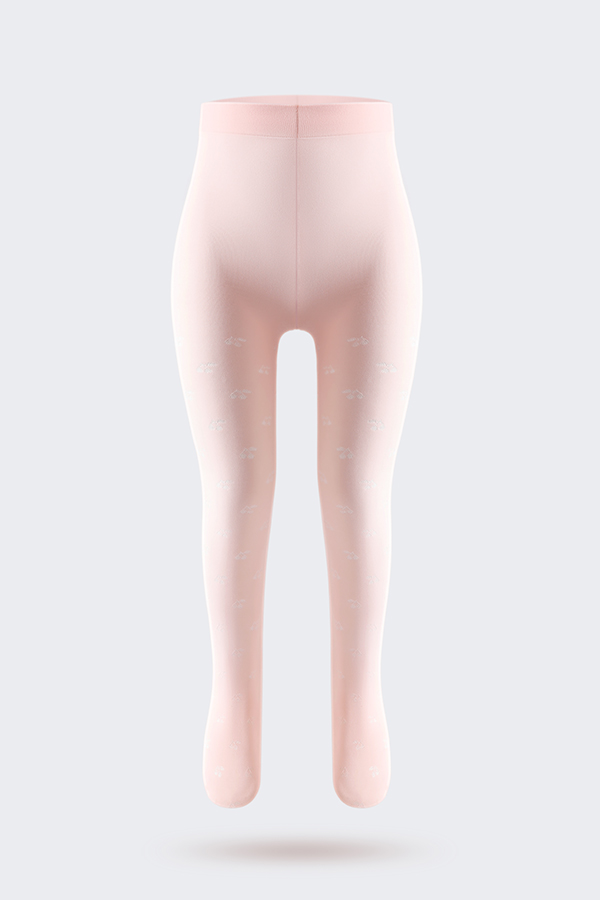
The Cherries Pattern Jacquard Kids Tights are created for children who need comfortable legwear for school, family outings, seasonal dressing, casual wear, and styled children’s fashion sets. The cherry motif gives the product a sweet, friendly, and lively personality. Unlike plain tights, patterned jacquard tights add detail without requiring extra accessories, making them easy to coordinate with dresses, skirts, long sweaters, coats, and winter outfits.
The product belongs to the Kids Tights category, a segment that demands special attention to fit, flexibility, fabric touch, and long-term wear performance. Children are naturally active; they sit, run, jump, stretch, crawl, and move throughout the day. Tights that look attractive but restrict movement quickly lose consumer appeal. These jacquard tights are designed to provide a secure but comfortable fit, supporting daily activity while maintaining an attractive silhouette.
The jacquard cherry pattern also gives this item a clear shelf advantage. For retailers and online sellers, pattern-driven hosiery can be easier to present visually than basic solid-color tights. The design immediately communicates personality and seasonality. Cherry patterns are often associated with sweetness, freshness, and childhood charm, making them suitable for spring and autumn collections, festive outfits, casual fashion photography, and gift-oriented product lines.
| Product Attribute | Details |
|---|---|
| Product Name | Cherries Pattern Jacquard Kids Tights |
| Product Category | Kids Tights |
| Style Code | 6026 |
| Pattern Type | Jacquard cherry pattern |
| Target Users | Children and kidswear consumers |
| Suitable Use | Daily wear, school outfits, casual styling, seasonal fashion, boutique collections |
| Production Strength | Whole-industry-chain hosiery manufacturing with OEM customization capability |
Jacquard knitting is a major advantage for patterned hosiery. In many lower-grade children’s tights, decorative motifs may be printed onto the fabric surface after knitting. Printing can be suitable for certain products, but it may fade, crack, or lose clarity after washing and friction. Jacquard construction, by contrast, forms the pattern through the knitting process itself. The design is built into the textile, giving it better durability and a more elegant appearance.
For kids tights, jacquard technology has several practical benefits. First, it supports longer-lasting visual quality. Children’s garments are washed frequently, and parents expect them to remain presentable after repeated use. A knitted-in cherry pattern can better resist surface wear than a purely printed design. Second, jacquard creates texture and depth, giving the tights a richer look. Third, it allows the product to stand out in a competitive market where many children’s tights rely only on basic colors or simple prints.
The Cherries Pattern Jacquard Kids Tights benefit from this construction by combining decoration and function. The fabric does not need excessive surface embellishment to look appealing. This is important because children’s hosiery should avoid unnecessary elements that may irritate the skin or interfere with comfort. By using the structure of the fabric to create the pattern, the product achieves visual charm while keeping the wearing experience smooth and practical.
Comfort is one of the most important performance standards for kids tights. Children may not explain fabric discomfort clearly, but they react quickly to tight waistbands, rough seams, itchy fibers, or restrictive stretch. A successful pair of tights must feel good from the first wear and continue to feel comfortable throughout a full day. The Cherries Pattern Jacquard Kids Tights are developed with the understanding that children need softness, flexibility, and reliable fit.
The knitted structure supports stretch and recovery, helping the tights move with the child rather than pulling against the body. Good stretch is especially important around the knees, hips, and waist, where movement places constant pressure on the garment. Shape recovery helps prevent sagging, bagging, or twisting after activity. For parents, this means the tights continue to look neat. For children, it means fewer distractions and better freedom of movement.
Softness is another key factor. Children’s skin is more sensitive than adult skin, so rough yarns or poor finishing can reduce product satisfaction. Through controlled yarn selection, knitting, dyeing, and finishing, a professional hosiery manufacturer can improve the hand feel of the finished product. The integrated production system of Zhejiang Chenyu Knitting Co., Ltd. supports this goal by managing each stage from yarn development to finished inspection.
The waistband and body fit also contribute to comfort. A waistband must hold securely without creating excessive pressure. If it is too loose, the tights slip down during play; if too tight, the child feels restricted. An experienced hosiery manufacturer understands how to balance elasticity, sizing, and garment structure to create a comfortable everyday fit. This manufacturing knowledge is a meaningful advantage over suppliers that only assemble products from outsourced materials without deep control over yarn and knitting quality.
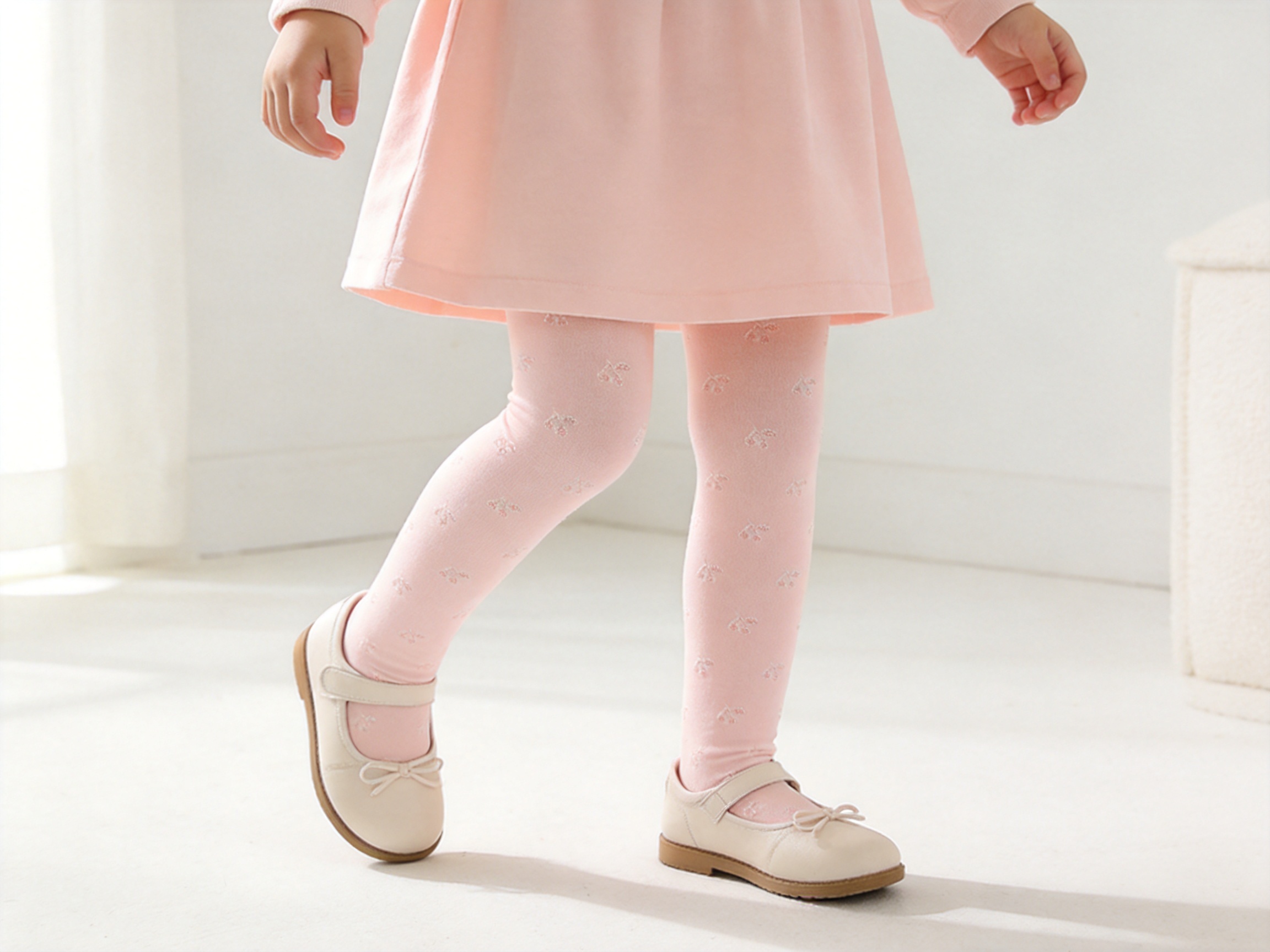
In the children’s hosiery market, many products compete mainly on price. However, buyers increasingly understand that low cost without quality control can lead to high return rates, poor customer reviews, inconsistent sizing, fading, pilling, and uncomfortable wear. The Cherries Pattern Jacquard Kids Tights are positioned to offer more than a decorative appearance. Their value lies in the combination of design, production control, fabric performance, and OEM scalability.
Compared with surface-printed tights, jacquard-patterned tights usually provide better pattern persistence. Since the cherry motif is created through the fabric structure, it is less dependent on surface ink or coating. This helps the product maintain a premium look after washing and daily friction. For online sellers, better durability can reduce negative reviews related to fading or worn graphics.
Jacquard gives the tights a refined textile character. The pattern appears more integrated and dimensional, which improves perceived value. In children’s fashion, small design details often influence purchase decisions. Parents may select a product because it looks well-made, while children may respond to the cheerful cherry motif. This dual appeal strengthens the product’s retail performance.
The company’s whole-industry-chain system supports better consistency than fragmented production models. When yarn development, spinning, elasticizing, wrapping, weaving, dyeing, shaping, inspection, and packaging are controlled within a coordinated system, it becomes easier to manage color, elasticity, fabric density, and finished size. This is important for OEM buyers who need repeatable product quality across bulk orders.
Many competitors offer standard stock products with limited adaptation. Zhejiang Chenyu Knitting Co., Ltd. has foreign trade, e-commerce, and OEM customization departments, enabling buyers to discuss product adjustments based on market needs. Customization may involve colorways, packaging formats, size ranges, yarn choices, thickness, finishing hand feel, or pattern development. This flexibility is valuable for brands that need exclusive product lines.
Kids tights require strict attention to details such as seam quality, elasticity, fabric defects, color consistency, and packaging accuracy. The company’s production flow includes full inspection, which helps ensure that finished goods meet commercial standards before shipment. For importers and retailers, inspection reduces risk and supports smoother supply-chain operations.
The quality of a pair of tights is not determined by one production step alone. It is the result of decisions made throughout the whole process, beginning with yarn and ending with packaging. Zhejiang Chenyu Knitting Co., Ltd. has built a comprehensive hosiery manufacturing chain that allows the company to manage product development and production with a high degree of technical control.
Yarn is the foundation of hosiery performance. The touch, stretch, durability, density, and appearance of tights all depend on yarn characteristics. Through yarn research and development, the manufacturer can select or create yarn solutions suitable for children’s products. For kids tights, yarns should support softness, flexibility, breathability, and stable dyeing performance. Effective yarn development also helps balance cost and quality for OEM clients.
Spinning and elasticizing influence the strength, uniformity, and stretch behavior of the yarn. A well-managed spinning process reduces irregularities that can cause fabric defects. Elasticizing improves the yarn’s ability to stretch and recover. For children’s tights, elasticity must be reliable but not harsh. The tights need to expand comfortably as the child moves, then return to shape after stretching.
Yarn wrapping is important for hosiery that requires both elasticity and comfort. Covered elastic yarns can provide stretch while helping protect skin from direct contact with harsh elastic cores. A well-executed wrapping process improves smoothness and performance. In the Cherries Pattern Jacquard Kids Tights, such technical control supports the balance between secure fit and gentle wear.
Greige weaving is where the fabric structure is created before dyeing and finishing. For jacquard tights, this stage is especially important because the pattern must be accurately formed in the knitted fabric. Precision during weaving helps ensure that the cherry motif appears clear, balanced, and consistent across sizes and production batches. Inconsistent knitting can lead to distorted patterns, uneven density, or poor fit, so technical expertise is critical.
Piecing connects garment parts and affects comfort, durability, and appearance. Poor piecing can create rough areas, weak seams, or uneven fit. Kids tights need smooth construction because children may be sensitive to pressure or friction. Skilled production helps ensure that the tights remain comfortable during active wear.
Dyeing is essential for visual quality. Color must be attractive, even, and consistent from batch to batch. Children’s fashion buyers often require specific color palettes, especially for seasonal collections. A manufacturer with in-house dyeing capability can better manage shade accuracy, color testing, and production scheduling. This reduces the risk of mismatched batches and supports better OEM project execution.
Finishing processes influence the final hand feel, appearance, and shape stability of the tights. Roughening can be used to improve softness or thermal comfort depending on the product design. Shaping helps the tights achieve the intended form and fit. A controlled finishing process enhances the product’s retail-ready quality and helps ensure that each pair looks neat in packaging.
Inspection is the final defense against quality problems. For kids tights, inspectors may check fabric defects, pattern accuracy, color consistency, sizing, seam condition, elasticity, and packaging details. Packaging then protects the product and presents it for retail or wholesale distribution. Strong inspection and packaging practices are valuable for OEM clients, especially those shipping to competitive international markets.
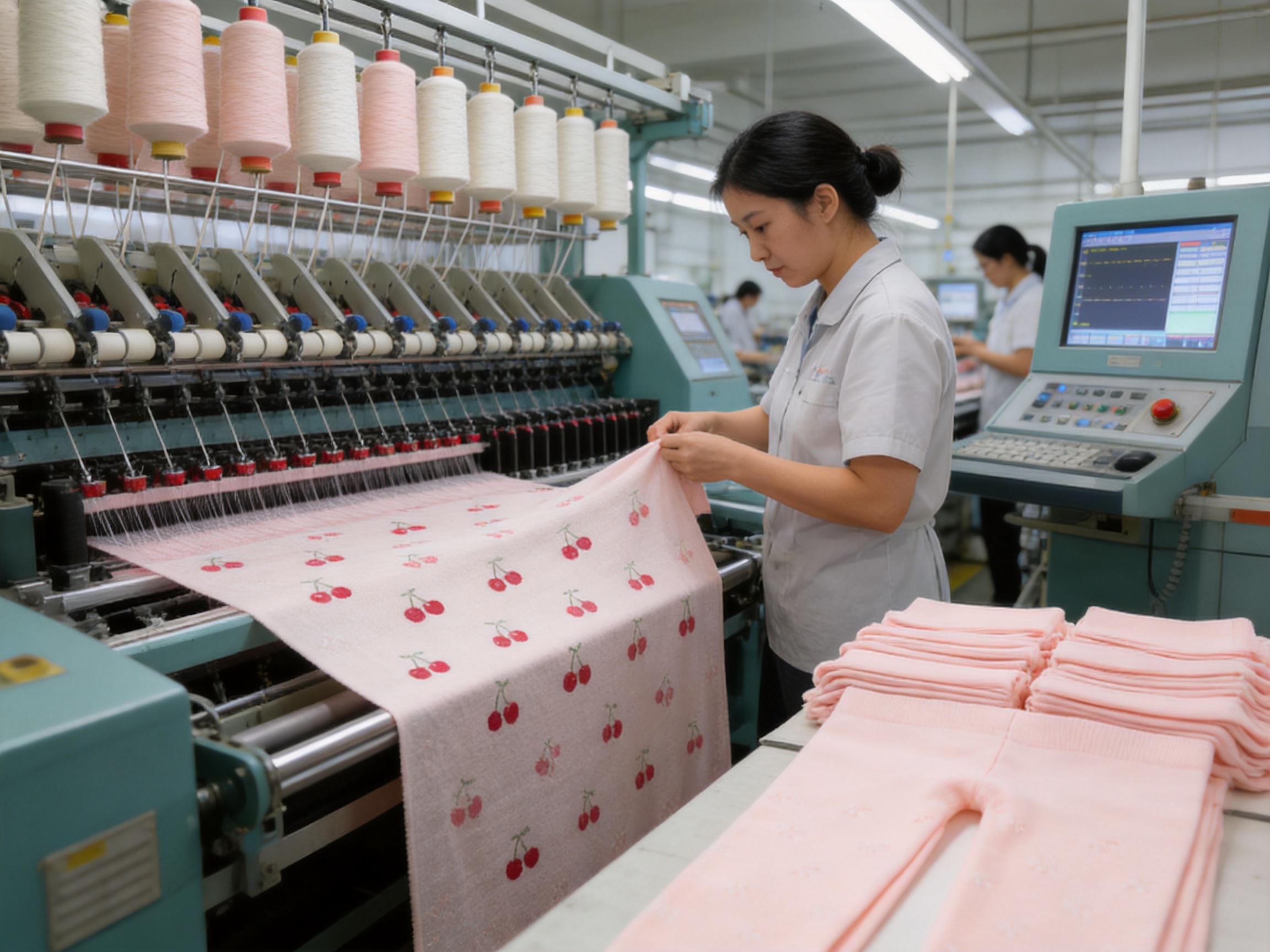
The cherry pattern has a natural advantage in children’s fashion. It is playful without being overly complex, recognizable without being too mature, and bright without requiring excessive ornamentation. Cherries suggest sweetness, freshness, and cheerful energy. On kids tights, this pattern can turn a basic outfit into a more expressive look.
Parents often look for children’s clothing that is cute but still practical. A cherry jacquard pattern satisfies this demand because it adds personality while keeping the garment easy to wear. The tights can be paired with solid-color dresses, denim skirts, knitted sweaters, long coats, and casual children’s shoes. The pattern provides a focal point without overwhelming the outfit.
For retailers, this type of design also supports better product photography. Patterned tights photograph well in lifestyle images, flat lays, and model shots. The cherry motif can help create an emotional connection with buyers, especially in online shopping environments where visual impact strongly affects conversion. The product’s image set provides multiple angles and styling possibilities, supporting e-commerce listings and catalog presentations.
Professional buyers evaluate kids tights based on more than appearance. They consider wear comfort, sizing accuracy, fabric recovery, colorfastness, seam durability, packaging, and supplier reliability. The Cherries Pattern Jacquard Kids Tights answer these expectations through a combination of thoughtful design and controlled manufacturing.
Comfort supports repeat purchase. If children enjoy wearing the tights and parents find them easy to wash and style, the product becomes more than a one-time purchase. Durability supports customer satisfaction by reducing early wear complaints. A stable supply chain supports retailers who need reorder availability or seasonal production planning. OEM flexibility supports private-label brands that need differentiation in a crowded market.
In competitive hosiery sourcing, buyers often face a trade-off between low price and dependable quality. This product is designed to reduce that trade-off by using manufacturing efficiency and full-process control to produce attractive, practical tights at commercial scale. The company’s long history in hosiery production gives it the experience needed to manage both product development and bulk manufacturing.
The Cherries Pattern Jacquard Kids Tights can serve as a ready product concept or as a starting point for customization. For private-label buyers, OEM flexibility is a major advantage. A buyer may want a similar cherry pattern in different colors, a modified waistband, alternative packaging, specific size grading, or a seasonal collection built around fruit, floral, animal, or geometric jacquard themes.
Zhejiang Chenyu Knitting Co., Ltd. has developed foreign trade, e-commerce, and OEM customization departments. This organizational structure supports communication with different types of customers, from international wholesalers to online retail brands. OEM buyers benefit from a supplier that understands both technical production requirements and market presentation needs.
Customization can also help brands build exclusivity. In children’s hosiery, many products look similar when sourced from generic suppliers. By working with an experienced manufacturer, brands can develop distinctive patterns, coordinated color sets, and packaging that match their market identity. This helps improve brand recognition and allows retailers to avoid direct price comparison with identical mass-market products.
Modern hosiery buyers increasingly care about environmental responsibility. The company’s SEO description emphasizes the adoption of sustainable fabrics to reduce environmental impact and contribute to a greener future. In kidswear, sustainability can influence both brand positioning and consumer trust. Parents are often attentive to the materials used for children’s clothing, and retailers may prefer suppliers that are moving toward more responsible fabric choices.
Sustainable fabric adoption does not remove the need for performance. Children’s tights still need softness, elasticity, durability, and easy care. The advantage of a technically capable manufacturer is the ability to explore sustainable material options while maintaining product quality. This may involve testing yarn behavior, dyeing performance, hand feel, color consistency, and wear resistance before moving into bulk production.
For OEM clients, sustainability can become part of a broader product strategy. A private-label buyer may request environmentally conscious material options, reduced packaging waste, or product lines designed for longer wear life. Longer-lasting tights can also support sustainability by reducing replacement frequency. When a product remains wearable and attractive after repeated use, it creates less waste than low-quality garments that are quickly discarded.
Fit is one of the most important factors in children’s tights. Kids grow quickly, and sizing must accommodate real movement, not just static measurements. A good pair of tights should sit comfortably at the waist, stretch smoothly over the hips and legs, and avoid excessive tightness around the knees or ankles. It should also stay in place during activity.
Jacquard tights must balance pattern structure with stretch. If the pattern is too rigid, the tights may feel restrictive or distort when worn. If the fabric is too loose, the garment may sag. Manufacturing expertise is necessary to achieve a stable balance between decorative patterning and functional elasticity. This is one reason why an integrated hosiery producer has an advantage over less specialized suppliers.
Practical wearability also includes care convenience. Parents prefer tights that can be washed regularly and return to shape. While specific care instructions depend on the final material composition and customer requirements, quality hosiery production generally aims for stable fabric behavior under normal care conditions. Good finishing and inspection improve the likelihood that products reach consumers in reliable condition.
Quality control in hosiery must address both visible and invisible factors. Visible issues include holes, snags, uneven patterns, poor seams, shade differences, and packaging mistakes. Invisible issues may include weak elasticity, inconsistent fabric density, or poor recovery after stretching. A professional manufacturer must manage all of these risks.
The company’s full inspection stage is especially important for kids tights. Because children’s products are often purchased by parents with high expectations, small defects can lead to dissatisfaction. Full inspection helps identify problems before goods are shipped. This protects the buyer’s reputation and reduces after-sales pressure.
Compared with competitors who rely on limited spot checks, a stronger inspection system can support more stable bulk quality. For international clients, this is valuable because product returns across borders are costly and time-consuming. A reliable supplier reduces risk not only through product quality, but also through predictable communication, production scheduling, and packaging accuracy.
The Cherries Pattern Jacquard Kids Tights are well suited for visual merchandising. On retail shelves, the cherry motif can attract attention among basic tights. In e-commerce, the pattern helps create clear product differentiation in thumbnails and listing images. Buyers can immediately understand the item’s style personality.
Product storytelling can also increase appeal. Retailers may present the tights as sweet, playful, comfortable, and suitable for daily outfits. The cherry pattern can be linked to seasonal themes, cheerful dressing, and giftable kidswear. For boutique children’s fashion brands, the tights can be part of coordinated collections with dresses, cardigans, and accessories.
OEM packaging can further strengthen brand identity. Depending on the buyer’s requirements, packaging may emphasize softness, jacquard craftsmanship, seasonal color, or sustainable material direction. Because the manufacturer has packaging included in its production system, buyers can discuss presentation needs along with product specifications.
Some hosiery suppliers operate mainly as trading companies or assembly coordinators. They may depend on multiple external factories for yarn, knitting, dyeing, finishing, and packaging. While this model can work for simple products, it may create challenges for quality consistency, communication, and delivery control. An integrated manufacturer offers a stronger foundation for technical hosiery products.
Zhejiang Chenyu Knitting Co., Ltd. has developed a one-stop whole-industry-chain production system. This creates advantages in research, production planning, cost control, quality management, and customization. When a buyer needs a change in yarn, color, pattern, or finishing, integrated production allows the manufacturer to evaluate the impact across the entire process rather than treating each step separately.
This is particularly valuable for jacquard kids tights. Pattern development depends on yarn behavior and knitting accuracy. Color appearance depends on dyeing and finishing. Comfort depends on yarn, elasticity, construction, and shaping. Final retail quality depends on inspection and packaging. A company that controls these stages can better coordinate the complete product result.
The product can be positioned in several market segments. For mainstream retail, it offers a charming patterned alternative to basic kids tights. For boutique children’s fashion, it provides a premium-looking jacquard design with a playful theme. For e-commerce, it offers strong visual appeal and clear keyword relevance. For OEM buyers, it provides a proven product concept that can be adapted for private-label collections.
Kids tights are often purchased seasonally, especially for cooler weather, school periods, holiday outfits, and family events. A cherry jacquard design can work across multiple seasons depending on color selection. Soft pastel versions may suit spring styling, while deeper tones can fit autumn and winter collections. This versatility increases the product’s commercial potential.
The tights also fit into broader hosiery category expansion. A buyer sourcing ankle socks, knee highs, hold-ups, garter stockings, tights, other hosiery, or kids tights may use this item to enrich the children’s line. It can sit alongside solid-color tights, ribbed tights, warm tights, and patterned socks as part of a complete hosiery assortment.
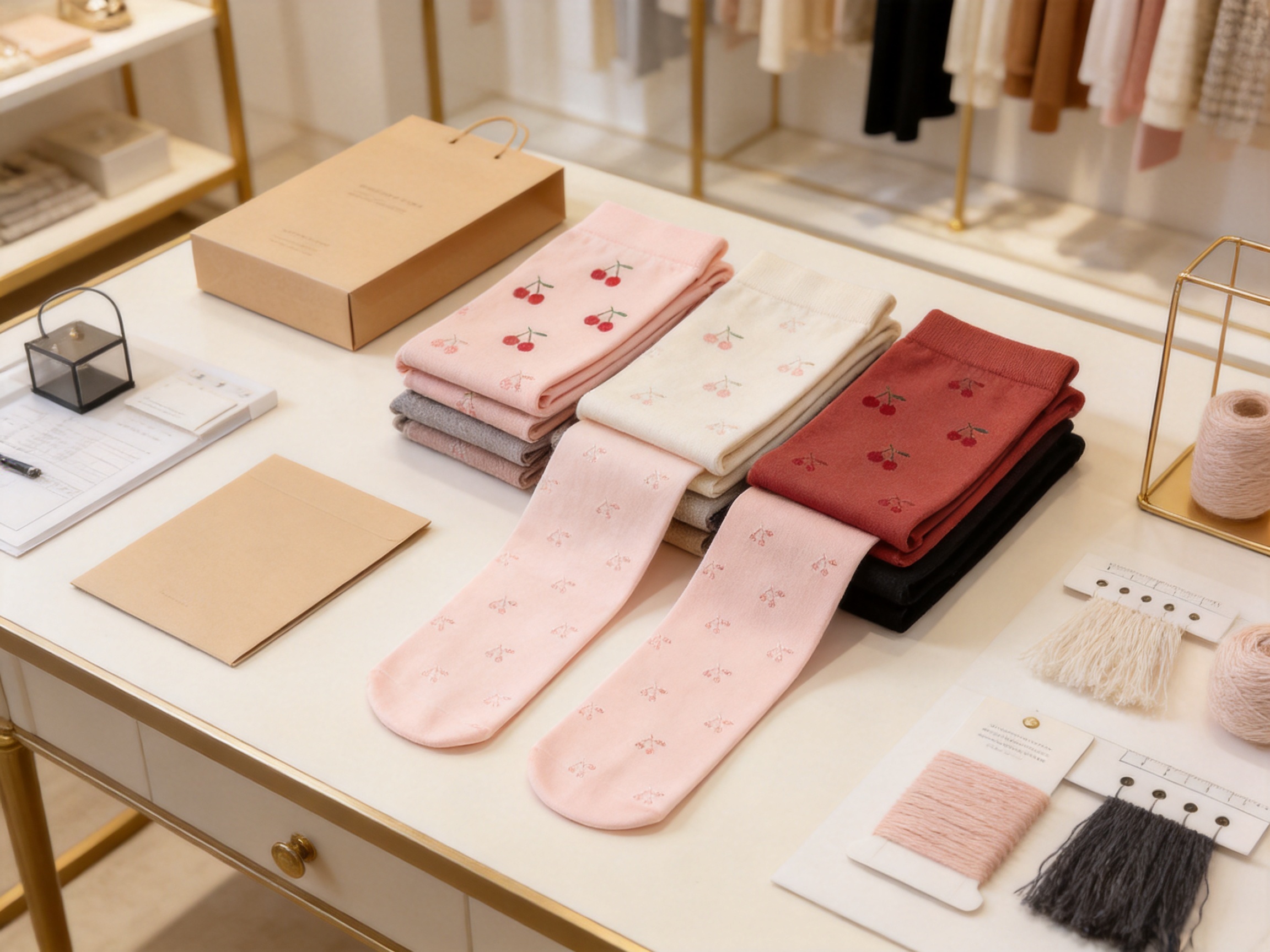
The main difference is the jacquard construction. The cherry pattern is formed through the knitting structure rather than only applied to the surface. This gives the tights better pattern durability, richer texture, and a more refined appearance compared with many printed alternatives.
Yes. The product is designed for children’s everyday outfits, including school, casual wear, family outings, and seasonal styling. The emphasis on softness, stretch, and shape recovery makes it suitable for active daily movement.
Kids tights require careful control of comfort, elasticity, size stability, seam quality, and fabric hand feel. An experienced hosiery manufacturer understands how each production stage affects the final product. This reduces quality risks and supports better bulk-order consistency.
Yes. Zhejiang Chenyu Knitting Co., Ltd. has OEM customization capability. Buyers may discuss adjustments such as color, size range, packaging, yarn choice, pattern direction, thickness, and finishing requirements, depending on production feasibility and order details.
A whole-industry-chain system allows the manufacturer to control yarn development, spinning, elasticizing, wrapping, weaving, dyeing, finishing, inspection, and packaging. This improves coordination, consistency, quality management, and customization efficiency.
The cherry motif is cheerful, recognizable, and suitable for children’s fashion. It adds charm without making the tights difficult to coordinate. It also photographs well for e-commerce and catalog presentation.
Full inspection helps detect defects before shipment, including fabric flaws, pattern issues, seam problems, color inconsistencies, and packaging errors. This reduces buyer risk and supports stronger customer satisfaction.
Yes. Sustainable fabric direction is increasingly important in hosiery and kidswear. The company emphasizes adopting sustainable fabrics to reduce environmental impact, and OEM buyers may explore suitable material options while maintaining comfort and performance.
The Cherries Pattern Jacquard Kids Tights combine playful design with practical hosiery performance. Their cherry motif provides strong visual appeal, while jacquard knitting supports pattern durability and a refined textile look. For children, the product is designed to be comfortable, flexible, and suitable for daily activity. For parents, it offers a charming and practical wardrobe item. For retailers and OEM buyers, it provides a commercially attractive product supported by experienced manufacturing.
The strength behind the product lies in the advanced production system of Zhejiang Chenyu Knitting Co., Ltd. With a history dating back to 1989, the company has developed comprehensive capabilities across yarn research and development, spinning, elasticizing, yarn wrapping, greige weaving, piecing, dyeing, roughening, shaping, full inspection, and packaging. This whole-industry-chain model gives the company a meaningful advantage over competitors with fragmented production or limited technical control.
In a market where children’s hosiery must satisfy style, comfort, durability, and supply reliability, this product stands out as an OEM-ready solution. It is not only a pair of patterned kids tights; it is the result of coordinated design, textile engineering, quality management, and market understanding. For buyers seeking charming children’s hosiery with dependable manufacturing support, the Cherries Pattern Jacquard Kids Tights offer a strong and competitive choice.
1. Textile Institute. Textile Terms and Definitions. Textile Institute Publications.
2. Saville, B. P. Physical Testing of Textiles. Woodhead Publishing.
3. Spencer, D. J. Knitting Technology: A Comprehensive Handbook and Practical Guide. Woodhead Publishing.
4. Kadolph, S. J. Textiles. Pearson Education.
5. Hatch, K. L. Textile Science. West Publishing Company.
6. Gong, R. H., and Wright, R. M. Fancy Yarns: Their Manufacture and Application. Woodhead Publishing.