
 English
  Español
  Deutsch
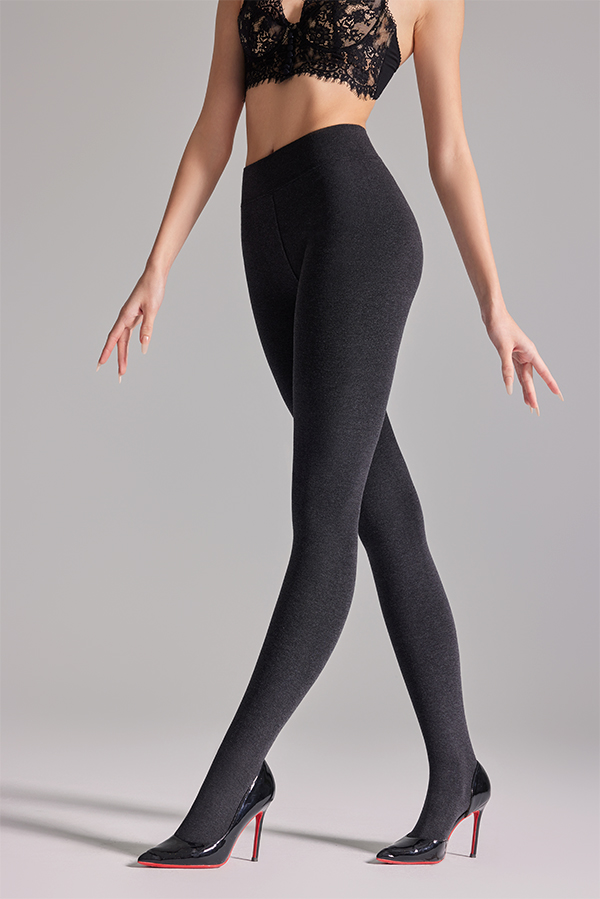
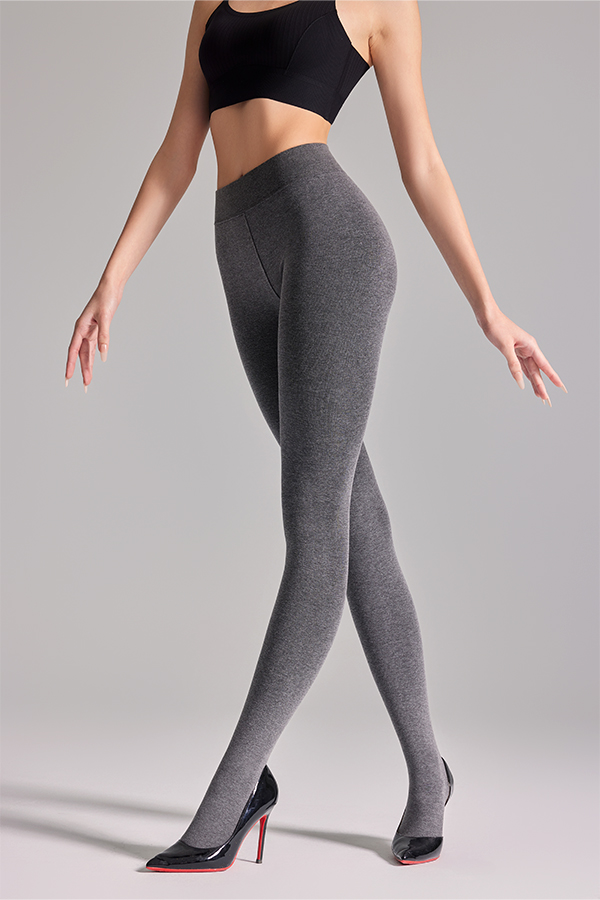
 Expanded panel thermal opaque tights

Our provided products
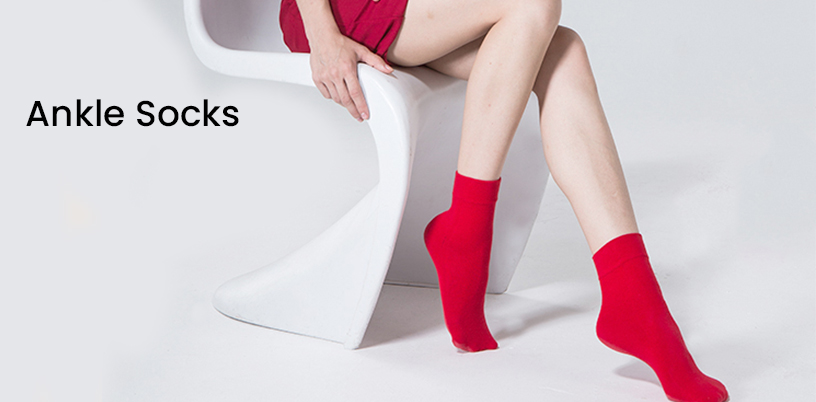
Black mid-calf socks are among the most versatile products in the hosiery market. They are suitable for business clothing, school uniforms, casual outfits, formal shoes, workwear, and everyday use. A well-designed pair must do more than cover the foot. It should provide a comfortable fit, maintain its appearance after repeated wear, complement a wide range of garments, and offer the durability expected by consumers and professional buyers.
The 3001 Core silk mid-calf socks in black are designed around these essential expectations. Their classic black color creates a clean and adaptable appearance, while the mid-calf height provides practical coverage between ankle socks and knee-high styles. The product is positioned as a refined basic for customers who value comfort, neat styling, and dependable hosiery construction.
Behind the finished sock is a manufacturing system capable of managing many stages of hosiery production in one coordinated structure. Zhejiang Chenyu Knitting Co., Ltd. has developed a production model that includes yarn research and development, spinning, elasticizing, yarn wrapping, greige weaving, piecing, dyeing, roughening, shaping, full inspection, and packaging. This integrated approach gives buyers access to a more consistent supply chain and supports the development of customized hosiery products.
For importers, distributors, retailers, uniform suppliers, and private-label brands, the combination of a commercially practical product and a complete manufacturing chain is especially valuable. It can simplify communication, support quality control, and make it easier to adapt product specifications for different markets.

3001 Core silk mid-calf socks black
The 3001 Core silk mid-calf socks black belong to the ankle-sock category in the supplied product classification, although the product name identifies them as mid-calf socks. In practical retail terms, the style is best understood as a low-to-medium leg sock that rises above the ankle and provides mid-calf coverage. Buyers should confirm the final height measurement, size range, fiber composition, and packaging specifications before placing an order.
The product is identified by the style number 3001 and the product alias “3001-core-silk-midcalf-socks-black.” The black colorway gives the design a broad commercial application. It can be paired with black trousers, denim, skirts, uniforms, formal footwear, sports-inspired casual shoes, and many other wardrobe combinations.
| Product Element | General Description | Commercial Value |
|---|---|---|
| Style number | 3001 | Supports product identification, sampling, and repeat ordering |
| Product type | Core silk mid-calf socks | Offers a practical everyday hosiery format |
| Color | Black | Provides strong versatility for fashion, workwear, and uniform programs |
| Coverage | Mid-calf style | Provides more coverage than ankle socks without the height of knee-highs |
| Target use | Daily wear, office clothing, uniforms, casual styling, and private-label collections | Suitable for several sales channels and customer groups |
| Manufacturing support | Integrated hosiery production system | Helps coordinate materials, knitting, finishing, inspection, and packaging |
The word “core” suggests a foundational or evergreen design intended to remain commercially relevant over time. Core products are important in a hosiery collection because they provide stable volume and can be sold across multiple seasons. Unlike highly seasonal fashion socks, a black mid-calf sock can remain in a basic assortment throughout the year.
The word “silk” in the product name communicates a smooth, refined, and comfortable product concept. However, the exact fiber content is not specified in the available product information. Buyers should request the confirmed composition and technical specifications from the manufacturer. Depending on the intended construction, the final product may use silk, silk-like fibers, or a blended yarn system designed to provide a smooth hand feel. Accurate fiber labeling is essential for retail compliance and customer transparency.
Hosiery buyers often seek products that combine clear consumer appeal with operational simplicity. Black mid-calf socks meet both requirements. They are easy to coordinate with existing wardrobes, suitable for repeat purchases, and appropriate for a wide range of age groups. Retailers can position them as a basic essential, a workwear accessory, a schoolwear item, or part of a premium comfort collection.
Black is also a practical color for daily use. It can visually coordinate with dark shoes and trousers, while helping create a polished appearance. For many customers, black socks are associated with professionalism, discretion, and convenience. They are often purchased in multiple pairs, making them suitable for multipacks, replenishment programs, and regular household shopping.
The mid-calf height fills an important space within the sock market. Ankle socks are low-profile and popular with casual footwear, but they may not provide enough coverage for formal trousers or certain uniforms. Knee-high socks provide greater coverage, but some customers may find them unnecessary for everyday wear. Mid-calf socks offer a balanced alternative, providing coverage and a secure appearance without extending to the knee.
For B2B customers, this versatility can reduce the need to manage many separate product categories. One well-developed mid-calf style may serve several retail and institutional applications. It can be offered as a standalone product or combined with ankle socks, knee-highs, tights, and other hosiery in a broader collection.
The 3001 black mid-calf socks can be presented as a practical wardrobe foundation. They are suitable for office wear when combined with dress shoes or loafers, and they can also be used with casual trousers, jeans, and everyday sneakers. Their simple color and classic height do not compete with the rest of an outfit, which makes them easier to recommend to customers who prefer understated accessories.
For uniform programs, a black sock can help maintain a consistent appearance across employees, students, service staff, or members of an organization. Uniform buyers normally value repeatability, size availability, color consistency, and reliable replenishment. A stable manufacturing partner can support these requirements more effectively than a supplier that depends on disconnected production stages.
Private-label brands often need products that are easy to understand and straightforward to merchandise. A black mid-calf sock does not require extensive consumer education. Its purpose is immediately clear, and the product can be described through familiar benefits such as comfort, coverage, smoothness, durability, and easy coordination.
The style can also be adapted to different brand positions. A value-focused brand may emphasize dependable everyday performance and multipack convenience. A premium brand may emphasize material selection, refined finishing, softness, presentation, and careful inspection. A sustainable brand may focus on responsible material choices and manufacturing transparency, provided that all environmental claims are supported by appropriate documentation.
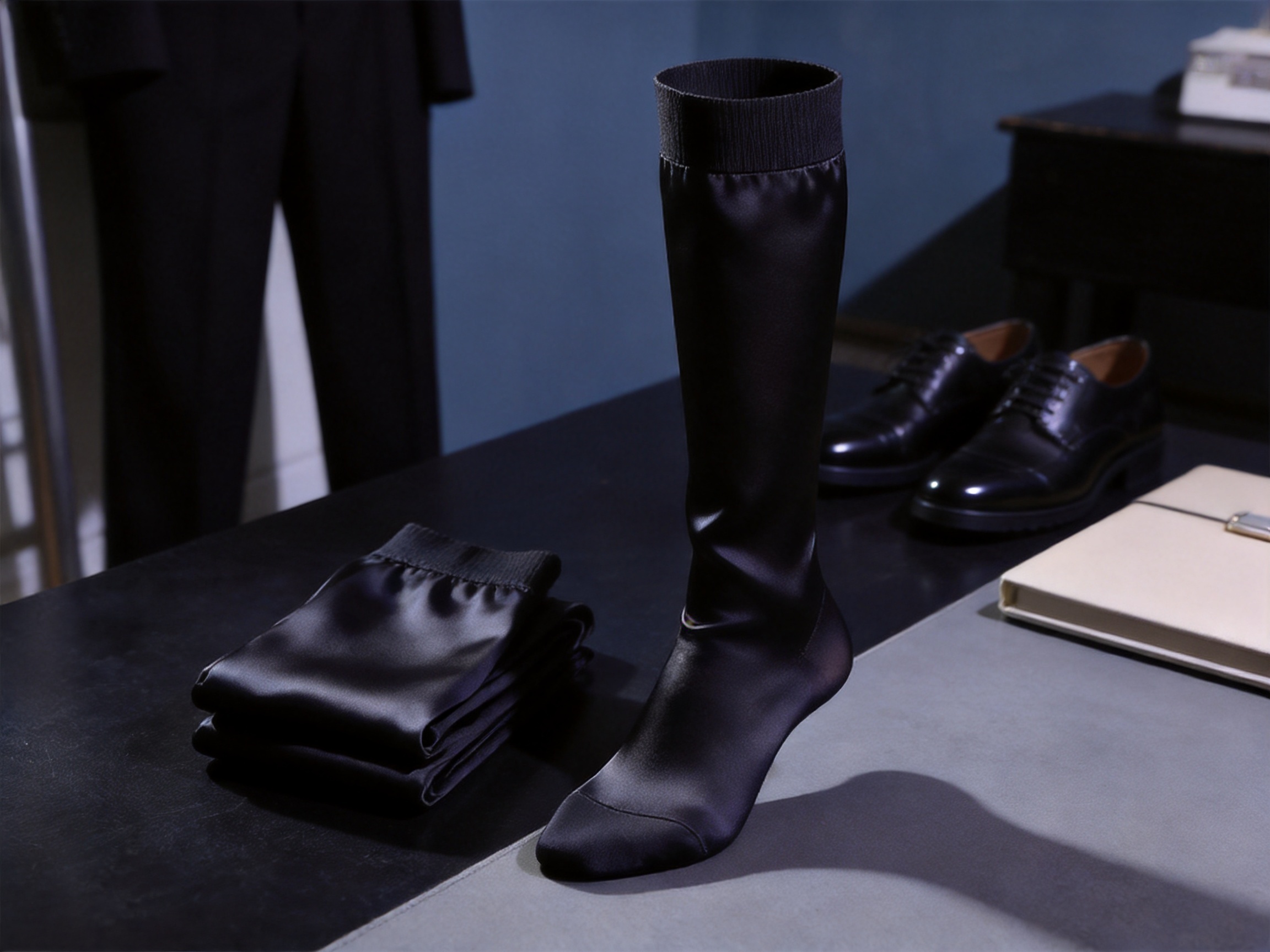
The performance of any sock depends on the relationship between yarn, knitting structure, elastic components, finishing, and sizing. A visually simple product may require careful control at every stage. Small inconsistencies in yarn tension, toe closure, dyeing, or shaping can affect comfort and appearance.
Yarn selection establishes the foundation for softness, strength, surface appearance, moisture behavior, and color response. The “silk” positioning of the 3001 style indicates a focus on a smooth and refined sensory experience. The exact yarn system should be confirmed according to the target market and the desired balance between luxury, durability, price, and care requirements.
For OEM buyers, yarn selection can be adjusted to meet a specific product brief. A brand may request a smoother surface for formal wear, a stronger construction for workwear, or a softer hand feel for direct-to-consumer collections. Material decisions should also consider labeling regulations, washing instructions, colorfastness expectations, and the final retail price.
A mid-calf sock must remain in position without creating excessive pressure. Elasticity is therefore an important part of the product experience. The opening should provide enough hold to reduce slipping, while the leg area should remain comfortable during sitting, walking, and extended wear.
Elasticizing and yarn-wrapping capabilities are part of the manufacturer’s stated production chain. These processes can support more controlled elastic performance and help align the yarn system with the intended product structure. The correct balance depends on the sock’s size range, leg dimensions, target consumer, and intended use.
For larger-volume programs, buyers should evaluate stretch and recovery through standardized testing and wear trials. Important points may include opening circumference, leg circumference, elongation, recovery after repeated stretching, and appearance after laundering. These checks help ensure that a sock performs consistently across production batches.
Knitting determines the basic structure, density, flexibility, and visual character of the sock. A well-controlled knitting process can support an even surface and a consistent shape. For a black product, surface uniformity is especially important because uneven density, streaks, or defects can be visible under light.
Greige weaving is included in the company’s integrated process description. At this stage, careful control can help establish a stable foundation before dyeing and subsequent finishing operations. The precise machinery and settings used for the 3001 style should be confirmed with the manufacturer, particularly when a buyer has requirements for gauge, stitch density, reinforcement, or technical performance.
The toe area is one of the locations where construction quality becomes immediately noticeable. A bulky or uneven toe seam can create pressure inside the shoe. A carefully finished toe can support a smoother and more comfortable wearing experience.
Buyers should request information about the toe-closing method, seam profile, reinforcement, and inspection standards. These details are especially relevant for premium positioning, long-duration wear, and customers who are sensitive to pressure points. The same considerations apply to the heel, where shaping and reinforcement can influence fit and durability.
Shaping helps the sock conform to the foot and leg. It also supports a consistent appearance after production. A sock that is not properly shaped may twist, bunch, or lose its intended silhouette during wear.
The stated production chain includes shaping as a dedicated stage. This indicates that the manufacturer recognizes the importance of post-knitting dimensional control. For OEM development, shaping parameters should be matched to the size chart, yarn behavior, knitting structure, and final finishing process.
The 3001 product benefits from being supported by a manufacturer with capabilities across many stages of the hosiery value chain. This does not automatically guarantee that every production batch will be perfect, but it creates a stronger foundation for coordination, traceability, and continuous improvement.
When yarn development, spinning, knitting, dyeing, shaping, inspection, and packaging are managed through a connected system, technical decisions can be communicated more directly. If a buyer identifies a problem related to color, elasticity, hand feel, or dimensional stability, the manufacturer can review multiple stages instead of relying solely on an external supplier’s explanation.
This can shorten the path between product development and corrective action. It can also make it easier to maintain the same specifications during repeat orders. In contrast, a fragmented supply chain may require several companies to coordinate, which can increase the risk of inconsistent materials, unclear responsibility, and delayed adjustments.
A company with yarn research and development, spinning, elasticizing, and yarn-wrapping capabilities has more opportunities to fine-tune the material foundation of a sock. This is useful when a buyer wants to modify softness, stretch, surface appearance, strength, or price positioning.
For the 3001 style, such capabilities may support different versions for different markets. One buyer may require a refined smooth feel, while another may prioritize high repeat-wear performance. Subject to technical feasibility and minimum order requirements, an integrated producer can help evaluate these objectives within the wider structure of the product.
Core products are often reordered over long periods. Consistency is therefore as important as the initial sample. Customers expect the black shade, dimensions, stretch, surface, and packaging to remain stable from one delivery to the next.
Integrated production can help reduce variation by establishing more controlled internal references. Retained samples, approved color standards, technical specifications, and inspection records can further support consistency. Buyers should still use formal approval procedures and specify tolerance ranges in purchase agreements.
OEM customers frequently need to discuss more than a single finished product. They may require assistance with material selection, labels, packaging, size grading, colors, logo placement, carton marks, or testing. A manufacturer with a broad internal production structure can serve as a central technical contact for these discussions.
This is particularly useful for overseas customers who want to reduce the number of separate suppliers involved in a collection. A centralized communication process can make product development easier to manage and can reduce the administrative burden associated with coordinating yarn suppliers, knitting factories, dye houses, finishing facilities, and packers independently.
Zhejiang Chenyu Knitting Co., Ltd. was founded in 1989 and is located in Dongyang, Zhejiang, China. According to the supplied company information, the business has developed through nearly four decades of continuous innovation and effort. Its activities include domestic brands, foreign trade, e-commerce, and OEM customization departments.
The company describes its production system as a one-stop whole-industry-chain operation. The stated process covers yarn research and development, spinning, elasticizing, yarn wrapping, greige weaving, piecing, dyeing, roughening, shaping, full inspection, and packaging. This range is significant because hosiery quality is influenced by the interaction of all these stages.
Yarn research allows a hosiery manufacturer to consider the material requirements of a product before knitting begins. For a smooth black mid-calf sock, the yarn must be selected with attention to surface appearance, elasticity, strength, dye uptake, and comfort.
Research and development also create opportunities to evaluate sustainable fabrics and alternative material strategies. The company’s supplied SEO description states that it adopts sustainable fabrics to reduce environmental impact and contribute to a greener future. Buyers should request specific information about the materials used in each product, including certifications, recycled content, responsible sourcing documentation, and applicable environmental testing where relevant.
Spinning affects yarn uniformity and strength. Yarn wrapping can combine or cover elastic and textile components in a way that supports stretch and recovery. These stages are particularly important for socks because the product must expand over the foot and leg while returning to its intended shape.
Control at the yarn level can help reduce downstream variation. It may also make it easier to develop different constructions for various price points. For example, a buyer may request a standard everyday version and a higher-grade version with a finer surface and more refined finishing.
Greige production provides the unfinished textile base before coloration and final treatments. At this stage, the manufacturer can monitor structure, density, defects, and dimensional behavior. Early detection is valuable because correcting a problem before dyeing and finishing can reduce waste and prevent additional processing costs.
For a black sock, the greige inspection stage can be especially helpful. Defects that may become more visible after dyeing should be identified as early as possible. The final inspection system should then confirm that the finished product meets the approved reference standard.
Black is commercially simple but technically important. Customers expect a deep, even shade with no unwanted variation between pairs or production lots. Dyeing must be managed with attention to shade matching, colorfastness, washing behavior, and the compatibility of the dye system with the chosen fibers.
OEM buyers should establish a black color standard before bulk production. This may include a physical approved sample, a recognized color reference, or an agreed instrumental tolerance. Testing should cover color change and staining after washing, rubbing, and other relevant conditions.
The company lists roughening among its production stages. Roughening may be used for selected product constructions to modify the inner or outer surface and influence warmth, softness, or tactile performance. The specific treatment required for the 3001 style should be confirmed according to the intended product design.
Finishing must be selected carefully because excessive treatment can affect the hand feel, appearance, elasticity, or care performance of a sock. A controlled process can help create the desired balance between softness and structural stability.
Full inspection is a major advantage for buyers seeking stable commercial quality. Inspection can include visual checks, measurement, pair matching, color consistency, seam evaluation, elasticity review, labeling verification, and packaging confirmation.
Packaging is also part of the customer experience. The 3001 socks may be supplied in packaging appropriate for wholesale, retail, e-commerce, or private-label programs. Buyers can discuss folding methods, size stickers, barcodes, hangtags, printed cards, polybags, multipacks, carton quantities, and export marks during the development process.

A professional purchasing program should define quality through measurable requirements rather than relying only on general descriptions such as “soft,” “high quality,” or “premium.” These terms are useful for marketing, but production teams need clear technical references and acceptable tolerances.
| Quality Area | Recommended Evaluation | Why It Matters |
|---|---|---|
| Fiber composition | Confirm declared fibers and percentages through documentation or testing | Supports accurate labeling and market compliance |
| Color | Compare against an approved black standard and check lot consistency | Protects the visual quality of the collection |
| Dimensions | Measure foot length, leg height, opening, and key widths | Helps ensure a predictable fit |
| Stretch and recovery | Evaluate elongation and recovery at the opening, leg, and foot | Reduces slipping, excessive pressure, and shape loss |
| Seams | Inspect toe closure, heel construction, loose threads, and seam uniformity | Supports comfort and reduces defects |
| Colorfastness | Test washing, rubbing, perspiration, and staining as required | Helps maintain appearance during use |
| Packaging | Verify labels, quantities, barcodes, size information, and carton marks | Prevents receiving and retail errors |
Fit should be assessed using the actual target size range. A sock may appear correct when evaluated on a single sample foot but perform differently across smaller and larger sizes. Buyers should provide a size chart that identifies foot length, shoe size conversion, leg circumference where relevant, and any regional sizing references.
Size grading must be consistent. If the product is offered in several sizes, the knitting and shaping parameters should be adjusted so that each size maintains the same design proportions and comfort objectives. A poorly graded product may feel too tight in larger sizes or appear loose in smaller sizes.
Durability depends on fiber selection, knitting density, reinforcement, seam construction, and customer care. Wear testing can help identify early thinning at the heel and toe, deformation at the opening, pilling, color change, and seam failure.
Care instructions should match the actual product composition and finishing. If the product name references silk or a silk-like quality, buyers should be particularly careful to confirm whether the sock requires gentle washing, low-temperature treatment, or other specific care guidance. The final label must be accurate and appropriate for the finished material.
Black hosiery should be checked for shade uniformity, streaks, patchiness, needle lines, holes, stains, lint, and visible construction irregularities. Pairs should be matched according to size, color, length, and appearance. Full inspection can be structured around approved samples and documented defect classifications.
Quality agreements should distinguish between critical, major, and minor defects. The acceptable quality limit, inspection level, sampling plan, and corrective-action procedure should be agreed before bulk production. These practices help protect both the manufacturer and the buyer by creating a shared understanding of acceptable quality.
Sustainability is increasingly important in hosiery purchasing. Buyers and consumers want to understand how fibers are sourced, how production affects the environment, how packaging is used, and how long the product is likely to remain wearable.
The company’s supplied information states that sustainable fabrics are adopted to reduce environmental impact and contribute to a greener future. This provides a basis for discussing responsible material options, but product-specific claims should be supported with relevant documentation. A buyer should ask which sustainable fibers are available for the 3001 style and whether they can be verified through recognized certifications or supply-chain records.
Durability is itself an important sustainability factor. A sock that retains its shape and appearance through repeated use may reduce the frequency of replacement. Therefore, sustainability discussions should consider both material origin and product performance. A balanced product brief may include requirements for fiber sourcing, colorfastness, dimensional stability, packaging reduction, and service life.
Material transparency begins with an accurate fiber composition. The name “silk” should not be treated as a substitute for a formal composition declaration. Buyers should confirm whether the product uses natural silk, regenerated cellulose, synthetic filament, blended yarn, or another construction. The final label, product page, and marketing materials should use terminology that matches the verified composition.
Documentation may include fiber certificates, transaction records, test reports, restricted-substance declarations, and other compliance materials required by the destination market. The exact requirements vary by region and sales channel.
Packaging can be optimized through compact folding, recyclable materials, reduced plastic use, and appropriately sized cartons. However, packaging decisions must also protect the socks from moisture, dust, deformation, and transport damage. Private-label buyers can discuss packaging alternatives during sampling so that presentation and environmental objectives are considered together.
The 3001 black mid-calf sock can serve as a starting point for OEM development. A buyer may retain the basic style while adjusting selected specifications to fit a brand’s market position. Customization should be approached systematically so that each change is evaluated for technical feasibility, cost, production timing, and compliance.
Potential adjustments may include fiber composition, yarn fineness, color depth, size range, leg height, foot length, opening construction, toe finishing, heel reinforcement, logo placement, packaging, and multipack configuration. Some adjustments may require new knitting programs, new yarn purchasing, or additional testing.
A buyer may also request color extensions beyond black. While black is an excellent core color, a broader collection could include navy, charcoal, white, grey, brown, or seasonal shades. The same base construction can sometimes be adapted for multiple colors, although every color requires appropriate shade approval and colorfastness evaluation.
Brand identity can be applied through woven labels, printed packaging, hangtags, stickers, carton marks, and customized presentation. The most suitable method depends on the order volume, desired appearance, packaging regulations, and retail channel.
For a premium collection, packaging may use a simple, refined layout that emphasizes the smooth quality and classic appearance of the sock. For a value collection, a multipack format may communicate convenience and price efficiency. For e-commerce, packaging should protect the product while remaining compact enough for fulfillment and shipping.
A reliable OEM workflow normally begins with a product brief. The brief should identify the target customer, intended use, fiber expectations, size range, color, construction preferences, packaging, estimated order quantity, destination market, and required delivery schedule.
The manufacturer can then review feasibility, recommend materials, prepare a sample, and provide preliminary technical information. After the buyer evaluates the sample, revisions may be made to fit, hand feel, color, dimensions, or packaging. A pre-production sample should be approved before bulk production begins.
During bulk production, the buyer and manufacturer should maintain communication regarding material arrival, production progress, inspection, packing, and shipment. A final inspection report and packing list can help make receiving more efficient.
The 3001 style can compete effectively when it is presented around practical and verifiable benefits rather than vague claims. Its strongest commercial points are the classic black color, useful mid-calf coverage, refined product concept, broad wardrobe compatibility, and support from an integrated hosiery manufacturer.
Compared with very basic low-cost socks, the product can be positioned around closer attention to material development, construction, shaping, finishing, and inspection. Compared with highly specialized performance socks, it offers a simpler and more versatile solution for everyday and formal applications. Compared with seasonal fashion designs, it has stronger potential as an evergreen replenishment product.
The product’s competitive value will ultimately depend on the confirmed specifications and commercial terms. Buyers should compare composition, weight, gauge, size range, testing, packaging, minimum order quantity, lead time, and price rather than evaluating the product by appearance alone.
| Comparison Factor | 3001 Black Mid-Calf Socks | Potential Buyer Benefit |
|---|---|---|
| Color versatility | Classic black | Easy to coordinate and suitable for multiple customer groups |
| Coverage | Mid-calf format | Balances comfort, modest coverage, and everyday practicality |
| Product positioning | Core silk-style basic | Can support premium, standard, or private-label merchandising |
| Supply-chain support | Integrated hosiery production system | Creates a central point for development and manufacturing communication |
| Quality management | Stated full-inspection capability | Supports more systematic defect control and batch consistency |
| Customization potential | OEM and customization departments | Allows adaptation for sizes, packaging, materials, and brand programs |
Retailers can merchandise the 3001 socks in several ways. A basic essentials section can present them as reliable everyday socks. A workwear display can associate them with trousers, dress shoes, and professional clothing. A comfort-focused collection can highlight the smooth product concept and careful construction. A private-label assortment can use the style as a permanent core item.
Multipack options may be effective for household buyers and consumers who prefer convenient replenishment. Single-pair premium packaging may be more appropriate for specialty retailers or gift-oriented collections. The correct format depends on the brand’s price architecture and customer expectations.
Product descriptions should be accurate and specific. Useful information includes the sock height, available sizes, confirmed fiber composition, color, care instructions, intended use, packaging quantity, and country of manufacture. If the product has been tested for particular performance characteristics, the test basis should be stated clearly.
Online product pages should use clear images showing the sock’s color, height, texture, opening, toe, heel, packaging, and fit. The supplied product image set contains four image files for the style, which can support a product page with multiple views. Buyers may use different images to show the overall silhouette, surface appearance, construction details, and packaging presentation.
Digital content should avoid suggesting properties that have not been verified. For example, a retailer should not describe the sock as pure silk, medically supportive, antibacterial, or certified sustainable unless the relevant specification and documentation exist. Clear descriptions build more trust than exaggerated claims.
Black mid-calf socks are naturally suited to office wardrobes. Their color coordinates with dark trousers and formal shoes, while their height provides a more finished appearance than a low ankle sock. The product can be marketed to professionals, commuters, hospitality workers, administrative staff, and customers who prefer classic dressing.
Uniform buyers need repeatable specifications and dependable delivery. The 3001 style can be considered for school uniforms, service uniforms, corporate dress codes, and institutional clothing programs, subject to the buyer’s requirements for composition, sizing, durability, and compliance.
The black color also works with casual clothing. Customers may wear the socks with jeans, chinos, casual trousers, sneakers, or walking shoes. This broad use makes the product suitable for general hosiery departments and online marketplaces.
Mid-calf socks are convenient for travel because they provide coverage without taking up much luggage space. They can be included in basic travel collections, work-trip packing lists, and seasonal wardrobe refreshes. Depending on the final fiber and construction, the product may be promoted for different seasons, but warmth and moisture claims should be supported by product testing.
Before confirming an order, buyers should request a complete technical and commercial package. This helps ensure that the product shown in a sample matches the product delivered in bulk.
First, confirm the product identity, including style number, color, sock height, size range, and intended application. Second, confirm the exact fiber composition and any available material certifications. Third, review the construction details, including knitting structure, toe closure, heel treatment, elastic performance, and finishing.
Next, establish a color standard and approve a pre-production sample. Discuss tolerances for dimensions, shade, pair matching, loose threads, holes, stains, and other defects. Confirm the inspection method and whether inspection is performed internally, by a third party, or by the buyer’s representative.
Packaging should be specified in writing. Include the number of pairs per unit, units per carton, carton dimensions, gross and net weight, barcode requirements, label language, care symbols, and shipping marks. These details can prevent avoidable delays during warehouse receiving and retail preparation.
Finally, review production capacity, minimum order quantities, sample lead time, bulk lead time, payment terms, shipping arrangements, and documentation requirements. A clear order process supports a better relationship and reduces the risk of misunderstanding.
The final care instructions for the 3001 socks must be based on the verified fiber composition and finishing process. In general, hosiery benefits from being washed according to the manufacturer’s instructions, using appropriate water temperature and avoiding treatments that may damage elastic fibers or delicate surfaces.
Customers should avoid excessive stretching during dressing and should keep sharp fingernails, jewelry, rough footwear, and abrasive surfaces away from the fabric. Proper shoe fit can also help reduce friction at the heel and toe. When socks are stored, they should be kept clean and dry rather than compressed in a way that places unnecessary stress on the elastic opening.
For retailers, including clear care information helps reduce misuse and supports customer satisfaction. Care labels should use the correct symbols and language for the destination market. If the product is made with a delicate material, this should be communicated clearly rather than implied only through the product name.
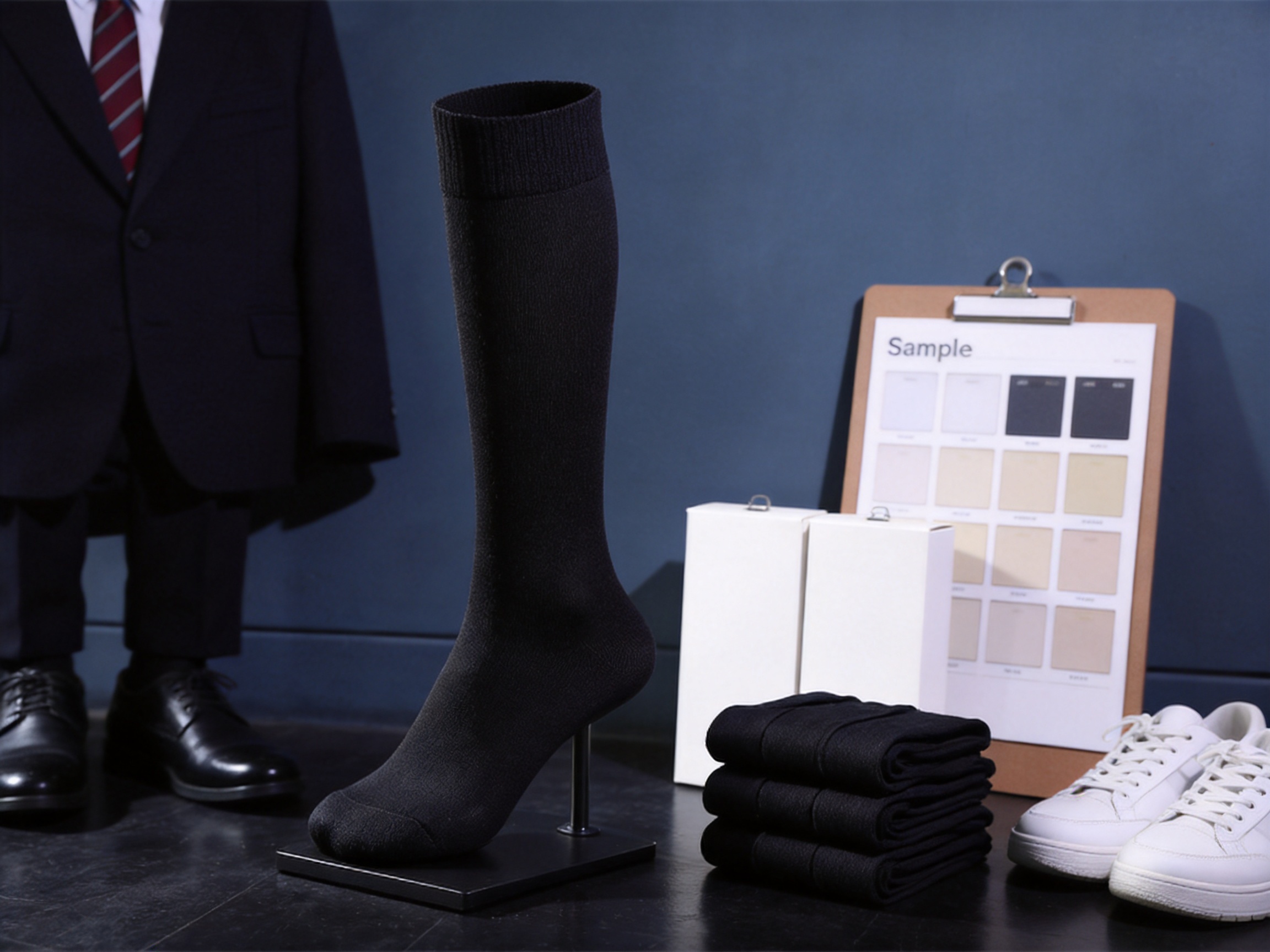
The 3001 style is identified as a core silk mid-calf sock in black. It is intended as a versatile everyday hosiery product with coverage between the ankle and knee. The precise height and construction measurements should be confirmed in the technical specification.
Black is easy to coordinate with formal, business, casual, and uniform clothing. It is also a practical color for repeat purchases and multipack programs. Retailers can sell it throughout the year without depending on a narrow seasonal trend.
The available information does not state the exact fiber composition. The term may describe the material concept, surface quality, or construction, but buyers must confirm whether the product contains natural silk, a silk-like fiber, or a blend. Retail labeling should be based on verified composition.
Yes. The manufacturer provides OEM customization services and has foreign trade, e-commerce, and OEM departments. Buyers can discuss changes to materials, sizes, colors, labels, packaging, and other specifications, subject to feasibility and order requirements.
The stated production chain includes yarn research and development, spinning, elasticizing, yarn wrapping, greige weaving, piecing, dyeing, roughening, shaping, full inspection, and packaging. The specific process sequence for the 3001 style should be confirmed during technical development.
Black is the specified color for this product. Other colors may be possible through OEM development, but each color requires shade approval, production evaluation, and appropriate colorfastness checks.
Buyers should confirm fiber composition, dimensions, size range, elastic performance, toe and heel construction, color standard, packaging, inspection criteria, minimum order quantity, production lead time, and destination-market compliance requirements.
The classic black color and mid-calf format can be suitable for uniform programs. The buyer should evaluate fit, durability, size availability, color consistency, care requirements, and replenishment capacity before approving the style for institutional use.
An integrated chain can provide more direct coordination across yarn, knitting, dyeing, shaping, inspection, and packaging. It may support better traceability, simpler communication, and more consistent repeat production than a highly fragmented supply arrangement.
Buyers should ask for the exact fibers used, responsible sourcing records, applicable certifications, recycled-content information, restricted-substance documentation, packaging options, and any product-specific environmental claims. Sustainability statements should be supported by appropriate evidence.
The 3001 Core silk mid-calf socks in black represent a practical and commercially adaptable hosiery product. Their classic color, useful mid-calf coverage, and refined product concept make them suitable for everyday wear, formal wardrobes, uniforms, private-label collections, and wholesale programs.
The product’s potential is strengthened by the manufacturer’s integrated approach to hosiery production. Capabilities covering yarn development, spinning, elasticizing, yarn wrapping, greige production, dyeing, roughening, shaping, inspection, and packaging create a foundation for coordinated manufacturing and OEM support.
For buyers, the most important next step is to convert the product concept into a complete technical specification. Confirm the fiber composition, measurements, construction, color standard, testing, packaging, and compliance requirements. With these details established, the 3001 style can function as a dependable core item within a broader hosiery assortment.
Its greatest competitive advantage is not based on appearance alone. It comes from the combination of an easy-to-sell black basic, a versatile height, a product concept centered on comfort and refinement, and access to a manufacturer with extensive hosiery production capabilities. For brands seeking a stable foundation for OEM development, this combination can support long-term product planning and consistent market presentation.
1. Product information supplied for the 3001 Core silk mid-calf socks black, including style number, category, color, product alias, and image references.
2. Company information supplied for Zhejiang Chenyu Knitting Co., Ltd., including company history, location, OEM activities, and integrated hosiery production capabilities.
3. Textile labeling and fiber identification principles for hosiery products, including the importance of verified fiber composition and accurate consumer information.
4. General quality-control practices for knitted hosiery, including dimensional measurement, color assessment, stretch and recovery evaluation, seam inspection, and packaging verification.
5. General sustainable textile procurement principles, including material traceability, certification review, responsible packaging, restricted-substance management, and product durability.